.jpg)
What has kept Dibasic Calcium Phosphate (DCP) relevant for more than half a century is not merely its role as a filler, but the fact that it possesses properties that very few other excipients can combine within a single material. Its brittle fracture compaction mechanism, low hygroscopicity, chemical inertness, and good flowability have made DCP a familiar choice in many tablet formulations, particularly direct compression systems.
However, not all Dibasic Calcium Phosphate grades share the same technological characteristics. The difference in hydration state alone creates significant variations in the material's functional performance. This is also why DCP Anhydrous and DCP Dihydrate often cannot be completely substituted for one another during formulation development, despite sharing the name Dibasic Calcium Phosphate.
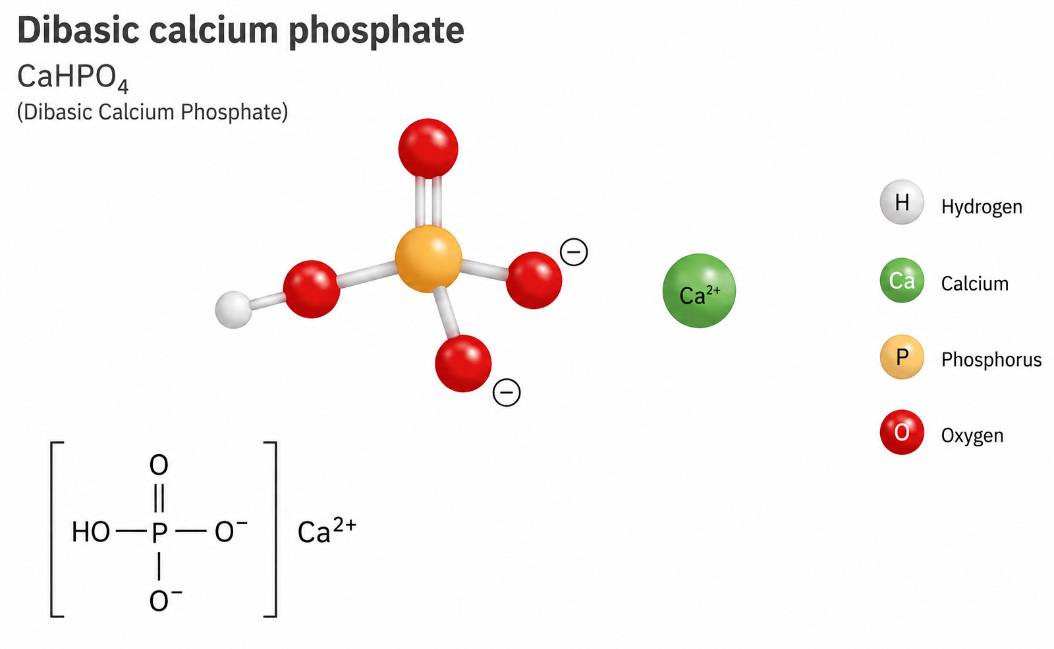
In essence, Dibasic Calcium Phosphate is an inorganic calcium hydrogen phosphate salt used primarily as a diluent/filler in solid dosage forms. Unlike organic fillers, DCP exhibits core characteristics that set it apart:
Hydration Form | Dibasic Calcium Phosphate Anhydrous (DCPA) | Dibasic Calcium Phosphate Dihydrate (DCPD) |
|---|---|---|
Particle Size | Available in two forms: fine powder and granular | Available in two forms: fine powder and granular |
Molecular Formula | CaHPO4 | CaHPO4.2H2O |
Molecular Weight | 136.06 g/mol | 172.09 g/mol |
True Density | 2.312 g/cm³ | 2.959 g/cm³ |
Melting Point | Does not melt; decomposes at approximately 425°C to form calcium pyrophosphate | Loses water of crystallization at temperatures below 100°C |
Hygroscopicity | Very slightly hygroscopic | Very slightly hygroscopic |
Surface pH¹ | Dependent on the manufacturing process:
• Standard powder grade: near-neutral pH
• Standard granular grade: pH 5.0 – 6.0 | Dependent on the manufacturing process:
• Typical pH: 7.0 – 8.0 |
Precautions | Surface pH differs between powder and granular DCPA; caution is required when modifying manufacturing processes for acid-sensitive APIs | Surface pH of DCPD is weakly alkaline; caution is required when co-formulating with alkali-sensitive APIs |
Dibasic Calcium Phosphate is utilized as a filler/diluent in the following formulations:
Application | DCP Grade | Active Pharmaceutical Ingredients (APIs) |
|---|---|---|
Direct compression with low cost and good flowability | • Granular DCPA
• Granular DCPD | • Paracetamol
• Chloroquine diphosphate
• Clobazam |
Amine-containing APIs | Selection of DCPA or DCPD depends on the acid-base sensitivity of the API | • Paroxetine
• Diclofenac sodium
• Ethambutol |
Vitamins or multivitamins | • Granular DCPA
• Granular DCPD | • Beta-Carotene
• Vitamins A, D, E, C, Riboflavin, Thiamine |
APIs stable in weak alkali and sensitive to acid | • Granular DCPD | • Desloratadine |
Moisture-sensitive APIs and/or APIs stable in weak acid | • Granular DCPA | • Lisinopril
• Sildenafil citrate |