(3).jpg)
Bilberry extract for eye health is directly extracted from the ripe fruits of Vaccinium myrtillus L., a shrub belonging to the Ericaceae family, primarily distributed throughout Northern Europe. In the field of medical product research and development, this vision-supporting ingredient is highly regarded for its complex system of low-molecular-weight flavonoid compounds, particularly the anthocyanin group.
High-performance liquid chromatography (HPLC) analyses have identified 15 different anthocyanins in bilberry extract, primarily glycoside derivatives of five major anthocyanidin aglycones, including Cyanidin, Delphinidin, Malvidin, Peonidin, and Petunidin. To ensure clinical pharmacological efficacy and consistency in large-scale industrial production, Bilberry extract for eye health must comply with stringent standardization requirements. According to official monographs from the European Medicines Agency (EMA), dried bilberry extract used in medicinal preparations is required to be standardized to contain 36% anthocyanosides, equivalent to 25% anthocyanidins when quantified using spectrophotometric methods.
This standardization ensures that the active compound concentration is sufficiently high to cross the blood-aqueous barrier and the blood-retinal barrier, allowing the compounds to reach target tissues within the eyeball and exert their biological effects.
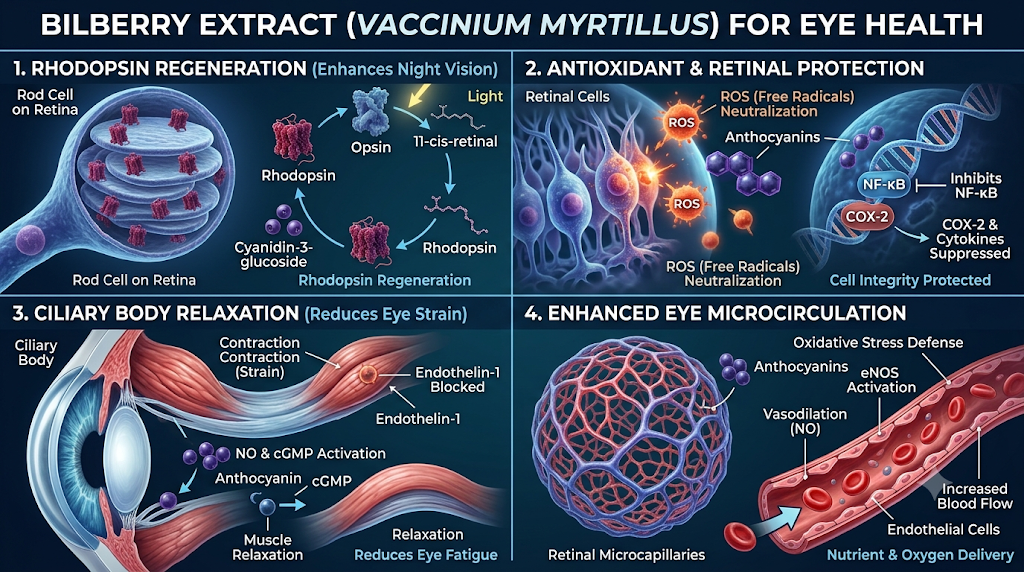
All visual signals under low-light conditions depend on rhodopsin, an optical pigment molecule located in the outer segments of retinal rod cells. Rhodopsin consists of the protein opsin tightly bound to the molecule 11-cis-retinal. Upon absorbing a photon of light, 11-cis-retinal undergoes isomerization into all-trans-retinal, dissociates from opsin, and leads to the bleaching of rhodopsin. This temporarily renders rod cells unable to detect light until the molecule is regenerated.
Molecular biology studies indicate that Bilberry extract for eye health participates directly in this visual cycle. Specifically, Cyanidin-3-glucoside compounds are reported to exhibit affinity interactions with the opsin structure, acting as biological catalysts that accelerate the recombination of opsin with newly synthesized 11-cis-retinal from the retinal pigment epithelium. By shortening the recovery time of rhodopsin, this ingredient helps enhance the adaptation speed of the eyes when transitioning from bright to dark environments, while also improving visual contrast sensitivity.
The retina is one of the tissues with the highest oxygen consumption rates in the body. It is continuously exposed to light and contains high concentrations of polyunsaturated fatty acids. These conditions make the retina a primary target for oxidative stress due to the continuous generation of reactive oxygen species (ROS), such as superoxide anions.
Preclinical data confirm the potential of Bilberry to protect the retina through the free-radical scavenging activity of the aromatic ring system containing multiple hydroxyl groups in the anthocyanin structure. Upon entering the retinal pigment epithelial membrane, anthocyanins from Bilberry extract for eye health not only act as electron donors to directly neutralize ROS but also modulate intracellular signaling pathways. They inhibit the nuclear translocation of the transcription factor NF-κB, thereby suppressing the expression of pro-inflammatory cytokines and structural-degrading enzymes such as cyclooxygenase-2. Consequently, the integrity of retinal neuronal cells is protected against aging-related processes.
Computer vision syndrome and eye strain primarily result from prolonged, involuntary contraction of the ciliary muscle when the eyes continuously accommodate to focus on near objects. If the ciliary muscle fails to relax, intraocular pressure may increase slightly, and the accommodative capacity of the lens may become impaired.
Pharmacological trials have reported that bilberry extract reduces eye strain through a mechanism involving the relaxation of smooth muscle in the ciliary body. Anthocyanins may antagonize endothelin-1, a peptide with potent vasoconstrictive and smooth muscle-contracting effects, while simultaneously stimulating the release of nitric oxide (NO) from endothelial cells. The increase in intracellular NO concentration activates the enzyme guanylate cyclase, elevates cGMP levels, and leads to relaxation of ciliary muscle fibers. This mechanism helps the eyes rapidly recover their accommodative function and reduces symptoms of tension around the eye sockets.
Maintaining the flexibility of the capillary system that supplies nutrients to the retina is essential for nourishing the optic nerve. Supplementation with this vision-supporting ingredient has been demonstrated to be an effective approach to enhancing ocular microcirculation. The primary mechanism involves anthocyanins protecting vascular endothelial cells from oxidative stress-induced damage and maintaining the stable activity of endothelial nitric oxide synthase.
This process leads to the natural dilation of the ocular microvascular system, increasing blood flow to the retina to deliver oxygen and support the elimination of metabolic waste products.
During product development, the physicochemical properties of Bilberry extract for eye health present significant challenges for formulation specialists. This ingredient is highly hygroscopic due to the presence of a network of free hydroxyl groups. When exposed to environments with relative humidity exceeding 40%, the ingredient rapidly absorbs moisture, resulting in caking and reduced flowability.
The deterioration of rheological parameters prevents the powder blend from flowing consistently into tablet compression dies or capsule-filling units. Furthermore, the presence of free water within the powder structure increases the rate of hydrolysis of glycosidic bonds, directly reducing the anthocyanin content. Therefore, the entire preparation, powder blending, and packaging processes must be performed under strictly controlled humidity conditions, ideally maintaining relative humidity below 30% and temperature below 25°C.
The stability of anthocyanin molecules in Bilberry extract for eye health strongly depends on the pH of the local environment. Anthocyanins maintain their most stable flavylium ion structure and characteristic dark red color in acidic environments ranging from pH 1 to pH 3. When the environment shifts toward neutral or alkaline conditions, their chemical structures rapidly undergo hydration, converting into colorless carbinol pseudobase forms or chalcones that are susceptible to oxidation and complete degradation.
Therefore, formulation design must strictly avoid the use of strongly alkaline excipient groups. Calcium carbonate, magnesium oxide, and sodium bicarbonate should be completely excluded from the formulation system. Research specialists should select chemically inert diluents with neutral to slightly acidic pH characteristics, such as microcrystalline cellulose, pregelatinized starch, and anhydrous dicalcium phosphate.
To preserve the active compound content of Bilberry extract for eye health, the optimal dosage form is hard capsules. This dosage form allows the application of a direct dry powder blending process, completely eliminating wet granulation and high-temperature drying steps that may potentially degrade anthocyanins. The capsule shell also serves as a physical barrier, reducing direct exposure of the ingredient to atmospheric moisture.
Regarding packaging solutions, products containing bilberry extract should preferably be packaged in cold-formed aluminum blister packs, also known as Alu-Alu blisters. The double aluminum layers provide an effective barrier against moisture vapor and ultraviolet light penetration. If packaged in multidose bottles, only opaque high-density polyethylene (HDPE) bottles or dark-colored glass bottles combined with appropriately sized silica gel desiccant sachets should be used.
| Image | Brand | Role of the Ingredient |
|---|---|---|
| Blackmores | Provides 80mg of standardized black blueberry dry extract. Plays a role in reducing eye fatigue, maintaining the health of the vascular system and ophthalmic capillary walls, and neutralizing intracellular free radicals. | |
| Swisse | Acting as a powerful antioxidant, it plays a core role in maintaining healthy visual function and reducing ophthalmic stress caused by lifestyles involving excessive screen time. | |
| Zipvit | It provides a rich source of natural anthocyanidins, which help reduce the strain on the ciliary muscles, supporting the maintenance of normal vision. |