Loading...
Loading...

Causes of Capping, Lamination, Cracking, and Chipping of Tablets

Detailed analysis of the physical mechanisms (air traps, shear stress, tensile stress) causing capping, lamination, cracking, and chipping defects. Includes a troubleshooting matrix.

Mở/Đóng

    Impact of compression force on tablet integrity
    1. Impact of compression force on tablet integrity

    During the tableting process, the powder is not merely "compressed into shape". Under the action of punches and dies, the powder bed undergoes a series of transformations regarding rearrangement, deformation, consolidation, and the formation of interparticulate bonds to create the tablet structure.
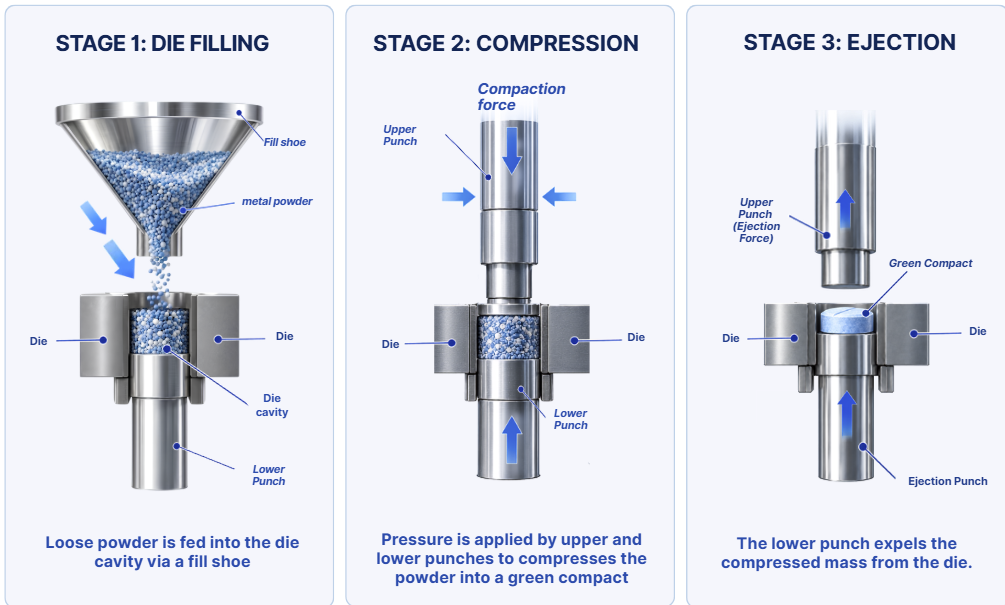
    Changes occurring at the end of the compression phase and the beginning of the ejection phase can create mechanical impacts on the formed tablet structure, affecting its ability to maintain integrity. The disruption of this structure can manifest in various forms of defects such as capping, lamination, cracking, and chipping.

    2. Analysis of Capping and Lamination defects: causes and mechanisms

    Capping and Lamination

    Definition:

    • Capping is the phenomenon where a partial or complete top/bottom crown (cup) of the tablet separates from the main body. This phenomenon occurs more frequently in biconvex tablets.
    • Lamination is the phenomenon where the tablet splits into two or more distinct layers, creating separation planes nearly parallel to the tablet surface.
    • Both phenomena are commonly observed after the tablet is ejected from the die or during subsequent processing.

    Mechanism:

    Capping There are 2 main mechanisms causing this phenomenon:

    • Shear stresses during ejection: At the end of the decompression phase, the elastic recovery of the tablet can create shear stress concentrated at the transition zone. When this stress exceeds the structural bearing capacity, it leads to crown separation. (Decompression → Elastic recovery + residual die wall pressure → Shear stress ↑ at the land-cup zone → Crack initiation → Capping)
    • Air entrapment: A high rate of force application forms a hard shell on the surface, restricting air escape and creating an uneven compression distribution. Upon decompression, elastic recovery and die wall friction during ejection increase stress at weak bonding zones, promoting capping. (High force application rate → Air entrapped → Uneven stress distribution → Elastic recovery upon decompression → Crack initiation → Capping)

    Lamination There are 3 main mechanisms causing this phenomenon:

    • Air entrapment: High tableting speed or poor air permeability → air is entrapped in the powder bed → internal air pressure increases upon decompression → generates tensile stress within the tablet → crack initiates and separates into layers.
    • Shear stresses during ejection: After decompression, elastic recovery combined with residual die wall pressure → shear stress arises at the tablet-die land-cup contact zone during ejection → cracks initiate from the tablet wall and propagate inward → Lamination.
    • Tensile stresses in biconvex tablets: In biconvex tablets, the decompression process can generate tensile stress at the central core → cracks initiate from the center and propagate horizontally → the tablet splits into layers.

    Causes:

    • Blend/Granule properties: Excessively fine or dry granules, high porosity, poor compressibility, uneven particle size distribution.
    • Formulation: Poorly compressible API, lack of binder, poorly compressible diluent, unbalanced brittle/elastic excipient ratio, excess lubricant.
    • Manufacturing process: Excessive fine granules generated (insufficient kneading, high milling speed, screen size, etc.), granules too dry, excessive lubrication time (over-lubrication), prolonged or improperly sealed granule storage.
    • Tableting parameters: Tableting speed too fast, dwell time too short, compression force too high, fill depth too deep, ejection cam too steep → high ejection force.
    • Tooling: Inappropriate punch design (excessive cup depth/curvature, sharp edges, etc.), lower punch not high enough above the die table during ejection, uneven lengths among lower punches.

    Cracking

    • Definition: Cracking is the phenomenon where cracks appear on the surface or within the tablet structure, disrupting the continuity of the structure but not yet resulting in complete separation into distinct parts.
    • Mechanism: During the decompression and ejection phases, elastic recovery combined with residual die wall pressure and tablet-die friction can create concentrated shear stress at transition or contact zones. When this stress exceeds the structure's bearing capacity, cracks can initiate and propagate, leading to Capping or Lamination depending on the failure location. There are 3 main mechanisms:
    • Tensile stresses: Tablet center → Crack initiation → Propagation
    • Shear stresses: Land-cup / tablet-die interface → Crack initiation → Propagation
    • Air entrapment: Internal air pressure ↑ → Stress ↑ → Crack initiation → Propagation

    Causes:

    • Blend/Granule properties: Granules too dry or too moist, uneven LOD, case-hardened granules, wide particle size distribution, overly porous granules, poor compressibility.
    • Formulation: Poorly compressible API, lack of binder, poorly compressible diluent, excessive glidant, lack of plastically deforming diluent, insufficient lubricant.
    • Manufacturing process: Inappropriate solvent amount and kneading time, unsuitable screen size and milling speed → wide PSD.
    • Tableting parameters: Compression force too low or too high, fill depth too deep, pre-compression not used or improperly set, tableting speed too fast, dwell time too short.
    • Tooling: Die walls worn, scratched, or uneven, inappropriate punch design (embossing too deep, sharp-angled punches, etc.), uneven lower punch lengths, take-off chute too low.

    Chipping

    • Definition: The phenomenon where a small piece of material is broken off from the edge or cup surface of the tablet, creating a visible chipped area.
    • Mechanism: Low interparticle bonding. Chipping forms when interparticle bonding strength at the edges is low, making this area unable to withstand stress from friction, ejection, or mechanical impacts. Cracks initiate at the load-bearing area, propagate, and cause a piece of material to separate from the tablet edge.
    • Flowchart: Low edge bond strength → Low local stress resistance → Occurrence of friction / ejection force / mechanical impact → Increased stress concentration at the edge → Crack initiation & propagation → Chipping

    Causes:

    • Blend/Granule properties: Granules too dry or too moist, uneven LOD, poor compressibility.
    • Formulation: Lack of binder, poorly compressible diluent, poorly compressible API, lack of plastically deforming diluent, excess brittle deforming excipients.
    • Manufacturing process: Insufficient granulating solvent, short wet massing time, inappropriate drying conditions, inappropriate milling parameters and screen sizes leading to wide PSD.
    • Tableting parameters: Tableting too fast, dwell time too short, take-off chute too low, lower punch below the die table during ejection.
    • Tooling: Inappropriate punch/die design (sharp edges/angles, etc.).

    CAUSES

    Phenomenon

    Granules / Blend

    Formulation

    Granulation Process

    Tableting Parameters

    Tooling

    Capping – crown separation


    Lamination – layering

    - Excessively fine granules

    - Granules too dry

    - High porosity

    - Poor compressibility

    - Uneven granules

    - Excessively wide particle size distribution

    - Poorly compressible API

    - Lack of binder

    - Poorly compressible diluent

    - Unbalanced brittle/elastic excipient ratio

    - Large total powder bulk (direct compression)

    - Large amount or lack of lubricant

    - Granulation method

    - Granulating liquid amount

    - Wet massing time

    - Impeller, chopper speed

    - Over-drying

    - Milling too fine (mill speed and screen size)

    - Lubrication time too long

    - Prolonged or unsealed storage altering granule texture and moisture

    - Tableting too fast

    - Dwell time too short

    - Compression too high

    - Pre-compression unused or ineffective

    - Fill depth too deep

    - Ejection cam too steep leading to high ejection force and fast ejection speed

    - Inappropriate punch design (excessive curvature, logo too deep, sharp-angled punch...)

    - Uneven punch lengths

    - Die surface worn, scratched, uneven

    - Lower punch not high enough above die table.

    - Take-off chute too low.

    Cracking – tablet cracking

    - Moisture too low or too high

    - Uneven LOD

    - Granules too hard

    - Uneven granules

    - Particle size distribution too wide, prone to segregation

    - Granules too large

    - Too many fine granules

    - Granules too porous
     

    - Poor compressibility

    - Poorly compressible API

    - Poorly compressible diluent

    - Lack of binder

    - Too much binder

    - Too much glidant

    - Lack of plastically deforming excipients

    - Lack of lubricant

    - Kneading solvent amount

    - Wet massing time and machine speed

    - Inappropriate drying conditions causing LOD too low or high

    - Screen and milling speed creating inappropriate PSD

    - Compression too low or high

    - Fill depth too deep

    - Pre-compression unused or inappropriate

    - Tableting too fast

    - Dwell time too short

    - Die surface worn, scratched, uneven

    - Inappropriate punch design (logo too deep, sharp-angled punch...)
     

    - Uneven punch lengths
     

    - Take-off chute too low

    Chipping – edge chipping

    - Moisture too dry or too high

    - Uneven LOD

    - Poor compressibility

    - Lack of binder

    - Poorly compressible diluent

    - Poorly compressible API

    - Lack of plastically deforming excipients, excess brittle excipients

    - Insufficient kneading solvent

    - Short wet massing time

    - Inappropriate drying conditions

    - Inappropriate milling parameters and screen leading to PSD

    - Tableting too fast

    - Dwell time too short

    - Take-off chute too low

    - Lower punch below die table during ejection

    - Inappropriate punch/die design (angles/edges...)

    3. TROUBLESHOOTING CAPPING, LAMINATION, CRACKING, CHIPPING

    The defect morphology of tablets reflects the type of structural failure and the source of stress generated during compression. To optimize troubleshooting time, the root cause investigation should be conducted according to the priority matrix below:

    Phenomenon

    Powder/Blend Properties

    Formulation

    Process

    Tableting Parameters

    Tooling

    Capping – crown separation

    23113

    Lamination – layering

    23113

    Cracking – tablet cracking

    11232

    Chipping – edge chipping

    23211

    1 = Check first 2 = Check next 3 = Check last

    • Chia sẻ qua viber bài: Causes of Capping, Lamination, Cracking, and Chipping of Tablets
    • Chia sẻ qua reddit bài:Causes of Capping, Lamination, Cracking, and Chipping of Tablets

    Bài viết liên quan

    Bacillus clausii and Bacillus subtilis characteristics and probiotics

    Analysis of the biological characteristics, endospore formation mechanisms, clinical differences, and probiotic preparations containing Bacillus clausii and Bacillus subtilis.

    Methylene chloride: properties, advantages, and role in pharmaceuticals.

    Learn about Methylene chloride (Dichloromethane – DCM): its physicochemical properties, safety standards, advantages of rapid evaporation, and applications as a film coating solvent and pharmaceutical extractor.

    Silicated Microcrystalline Cellulose: Advanced Silicification Solution with Enhanced Technological Properties

    Learn about Silicified Microcrystalline Cellulose (SMCC) – a co-processing solution for MCC with 2% colloidal silicon dioxide that enhances flowability, compressive strength, and optimizes straight forging.

    Analysis of the combined formulation of Aluminum Hydroxide, Magnesium Hydroxide, and Simethicone

    Analysis of the synergistic mechanism between Aluminum Hydroxide, Magnesium Hydroxide, and Simethicone in neutralizing gastric acid, breaking down gas bubbles, and controlling digestive symptoms.

    Distinguishing between Dibasic Calcium Phosphate Anhydrous and Dihydrate

    Analysis of technological differences between Dibasic Calcium Phosphate Anhydrous and Dihydrate in terms of physicochemical parameters, surface pH, and application selection of direct compression excipients.

    Properties and applications of Sodium Bicarbonate and Calcium Carbonate

    This article provides a detailed analysis of the physicochemical properties, acid neutralization mechanisms, and practical applications of Sodium Bicarbonate and Calcium Carbonate in pharmaceuticals.

    Mở/ĐóngMở/Đóng