Loading...
Loading...

Distinguishing between Dibasic Calcium Phosphate Anhydrous and Dihydrate

Analysis of technological differences between Dibasic Calcium Phosphate Anhydrous and Dihydrate in terms of physicochemical parameters, surface pH, and application selection of direct compression excipients.

Mở/Đóng
    Comparison of Dibasic Calcium Phosphate Anhydrous and Dihydrate in Formulation Design


    1. Comparison of Dibasic Calcium Phosphate Anhydrous and Dihydrate in Formulation Design

    What has kept Dibasic Calcium Phosphate (DCP) relevant for more than half a century is not merely its role as a filler, but the fact that it possesses properties that very few other excipients can combine within a single material. Its brittle fracture compaction mechanism, low hygroscopicity, chemical inertness, and good flowability have made DCP a familiar choice in many tablet formulations, particularly direct compression systems.

    However, not all Dibasic Calcium Phosphate grades share the same technological characteristics. The difference in hydration state alone creates significant variations in the material's functional performance. This is also why DCP Anhydrous and DCP Dihydrate often cannot be completely substituted for one another during formulation development, despite sharing the name Dibasic Calcium Phosphate.
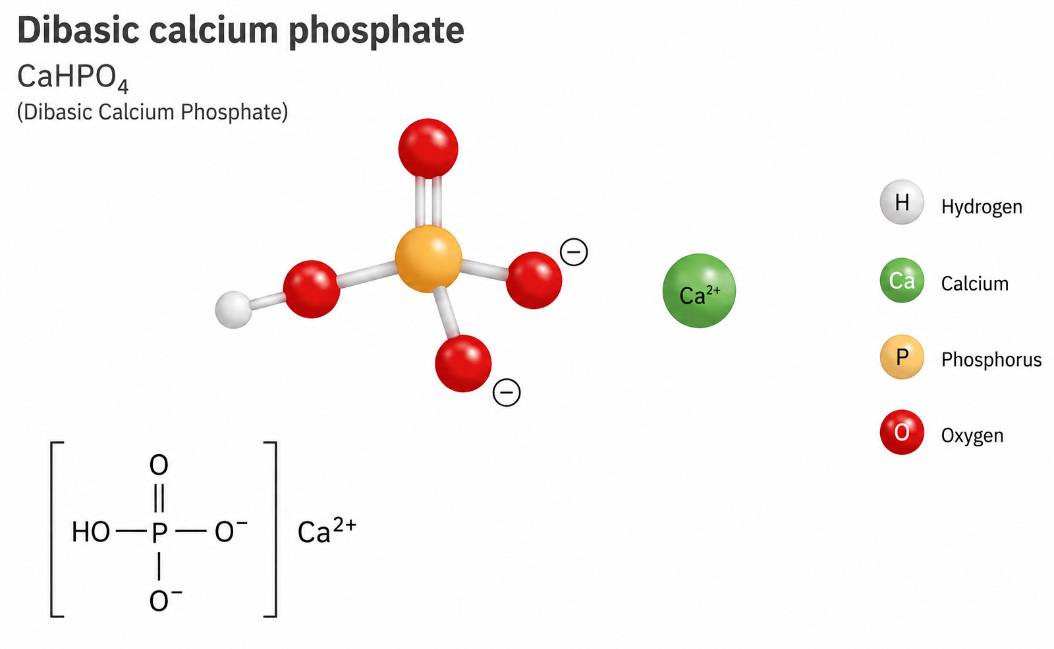
    2. Why Dibasic Calcium Phosphate Excipient Is Favored in Direct Compression
     

    In essence, Dibasic Calcium Phosphate is an inorganic calcium hydrogen phosphate salt used primarily as a diluent/filler in solid dosage forms. Unlike organic fillers, DCP exhibits core characteristics that set it apart:

    • Optimal combination of direct compression and cost-effectiveness: Unlike many direct compression excipients that require complex granulation processes, DCPD is widely favored due to its excellent flowability, low hygroscopicity, and low cost.
    • Brittle fracture compaction mechanism: Under compression force, DCP particles fracture into numerous smaller fragments, generating new clean surfaces. This property makes DCP virtually immune tolubricant over-blending and insensitive to final blending process parameters during scale-up.
    • Chemical inertness: As an inorganic salt, DCP contains no reducing carbonyl groups, completely eliminating the risk of the Maillard reaction—a critical drawback of Lactose. Furthermore, DCP exhibits extremely low hygroscopicity compared to cellulose- or starch-based fillers.
    • High bulk density and superior free-flowing properties (coarse/unmilled grade): In direct compression formulations, DCP allows for maximum reduction of tablet size in high-dose formulations while laying the foundation for optimizing manufacturing cycle times.

    3. Classification and Parameter Comparison of Dibasic Calcium Phosphate Anhydrous and Dihydrate

    Technical Specifications Comparison Table

    Hydration Form

    Dibasic Calcium Phosphate Anhydrous (DCPA)

    Dibasic Calcium Phosphate Dihydrate (DCPD)

    Particle Size

    Available in two forms: fine powder and granularAvailable in two forms: fine powder and granular

    Molecular Formula

    CaHPO4 CaHPO4.2H2O 

    Molecular Weight

    136.06 g/mol172.09 g/mol

    True Density

    2.312 g/cm³2.959 g/cm³

    Melting Point

    Does not melt; decomposes at approximately 425°C to form calcium pyrophosphateLoses water of crystallization at temperatures below 100°C

    Hygroscopicity

    Very slightly hygroscopicVery slightly hygroscopic

    Surface pH¹

    Dependent on the manufacturing process:


    • Standard powder grade: near-neutral pH


    • Standard granular grade: pH 5.0 – 6.0

    Dependent on the manufacturing process:


    • Typical pH: 7.0 – 8.0

    Precautions

    Surface pH differs between powder and granular DCPA; caution is required when modifying manufacturing processes for acid-sensitive APIs

    Surface pH of DCPD is weakly alkaline; caution is required when co-formulating with alkali-sensitive APIs

    4. Applications of Dibasic Calcium Phosphate in Solid Dosage Formulations

    Dibasic Calcium Phosphate is utilized as a filler/diluent in the following formulations:

    Applications of DCP in Pharmaceutical Formulations

    Application

    DCP Grade

    Active Pharmaceutical Ingredients (APIs)

    Direct compression with low cost and good flowability

    • Granular DCPA


    • Granular DCPD

    • Paracetamol


    • Chloroquine diphosphate


    • Clobazam

    Amine-containing APIs

    Selection of DCPA or DCPD depends on the acid-base sensitivity of the API

    • Paroxetine


    • Diclofenac sodium


    • Ethambutol

    Vitamins or multivitamins

    • Granular DCPA


    • Granular DCPD

    • Beta-Carotene


    • Vitamins A, D, E, C, Riboflavin, Thiamine

    APIs stable in weak alkali and sensitive to acid

    • Granular DCPD• Desloratadine

    Moisture-sensitive APIs and/or APIs stable in weak acid

    • Granular DCPA

    • Lisinopril


    • Sildenafil citrate

    • Chia sẻ qua viber bài: Distinguishing between Dibasic Calcium Phosphate Anhydrous and Dihydrate
    • Chia sẻ qua reddit bài:Distinguishing between Dibasic Calcium Phosphate Anhydrous and Dihydrate

    Bài viết liên quan

    Bacillus clausii and Bacillus subtilis characteristics and probiotics

    Analysis of the biological characteristics, endospore formation mechanisms, clinical differences, and probiotic preparations containing Bacillus clausii and Bacillus subtilis.

    Methylene chloride: properties, advantages, and role in pharmaceuticals.

    Learn about Methylene chloride (Dichloromethane – DCM): its physicochemical properties, safety standards, advantages of rapid evaporation, and applications as a film coating solvent and pharmaceutical extractor.

    Silicated Microcrystalline Cellulose: Advanced Silicification Solution with Enhanced Technological Properties

    Learn about Silicified Microcrystalline Cellulose (SMCC) – a co-processing solution for MCC with 2% colloidal silicon dioxide that enhances flowability, compressive strength, and optimizes straight forging.

    Analysis of the combined formulation of Aluminum Hydroxide, Magnesium Hydroxide, and Simethicone

    Analysis of the synergistic mechanism between Aluminum Hydroxide, Magnesium Hydroxide, and Simethicone in neutralizing gastric acid, breaking down gas bubbles, and controlling digestive symptoms.

    Properties and applications of Sodium Bicarbonate and Calcium Carbonate

    This article provides a detailed analysis of the physicochemical properties, acid neutralization mechanisms, and practical applications of Sodium Bicarbonate and Calcium Carbonate in pharmaceuticals.

    Causes of Capping, Lamination, Cracking, and Chipping of Tablets

    Detailed analysis of the physical mechanisms (air traps, shear stress, tensile stress) causing capping, lamination, cracking, and chipping defects. Includes a troubleshooting matrix.

    Mở/ĐóngMở/Đóng