(18).jpg)
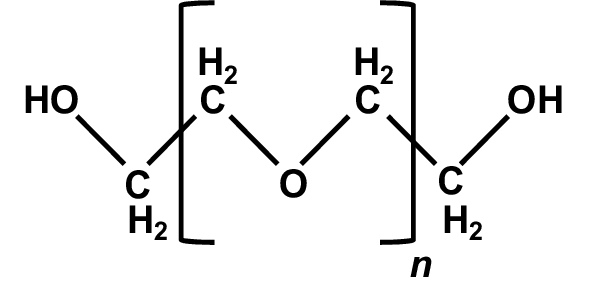
Polyethylene glycol (PEG), also known as Marcogol, is a linear polymer composed of ethylene glycol monomers -(CH₂CH₂O)-, typically with molecular weights ranging from 200 to 20,000 Da. Thanks to its high hydrophilicity, flexibility, biocompatibility, and non-toxicity, PEG is widely used in various dosage forms such as injectable drugs, topical medications, eye drops, oral medications, suppositories, and advanced drug delivery systems.
| ||||||||||||||||||||||||||||||||
| ||||||||||||||||||||||||||||||||
200 | 600 | 900 | 4000 | 6000 | 20000 | |||||||||||||||||||||||||||
Liquid state at room temperature | Solid state at room temperature | |||||||||||||||||||||||||||||||
Freezing temperature 4 - 15°C | Melting point increases gradually (35 - 63°C) | |||||||||||||||||||||||||||||||
Highly hygroscopic | Relatively hygroscopic | It absorbs almost no moisture. | ||||||||||||||||||||||||||||||
Viscosity increases gradually (3.9 – 3200 mm²/s at 98.9 ± 0.3°C) | ||||||||||||||||||||||||||||||||
Soluble in water and ethanol. Insoluble in oils and fats.
| ||||||||||||||||||||||||||||||||
Application | Dosage form | Commonly used PEG formulations | Advantages of PEG |
Dung môi | Soft capsules (aqueous solution) | 300, 400, 600 | ✔ Co-solvent - increases the solubility of the active ingredient ✔ High biocompatibility ✔ Stable over a wide pH range. |
| Topical | 300, 400, 600 | ||
| Injectable medications, eye drops, nasal drops, ear drops | 300, 400 | ||
Chất ổn định nhũ tương | Topical emulsion | 400 | ✔ Increase the viscosity of the dispersion medium (continuous phase). |
| Oral emulsion | 400 | ||
Tá dược gây treo, tạo đặc, ổn định | Oral suspension | 400 | ✔ Dissolves well, quickly, and is easy to mix in production. |
Chất hóa dẻo | Film-coated tablets | 3350, 4000, 6000 | ✔ Improve the mechanical properties of the coating film. ✔ Compatible with many polymers |
| Microencapsulated preparations | 300, 400 | ✔ Increases flexibility and prevents cracking of microencapsulated membranes. | |
Matrix-forming agent releases transformations | Modified-release tablets | 4000, 6000 | ✔ Compatible with many polymers ✔ Combine PEGs to regulate the release rate. |
Creating a base for topical medications | Ointments, creams, gels | 1450, 3350, 4000 | ✔ Does not irritate the skin. ✔ Excellent moisturizing properties. ✔ Compatible with many active ingredients. ✔ Combines PEGs to adjust to desired texture. |
Create a base for the suppository | suppositories | 3350, 4000, 6000 | ✔ Stable structure, unfavorable for mold growth ✔ Improves the mechanical properties of the drug ✔ Compatible with many active ingredients |
Binding excipients | Tablets | 6000 | ✔ Increases particle binding capacity ✔ Improves the mechanical strength of granules and tablets |
Melting process | Molten granulation, molten extrusion, solid dispersion systems | 4000, 6000 | ✔ Suitable viscosity ✔ Even dispersion of the active ingredient ✔ Low melting point ✔ Combination of PEGs to adjust desired properties |
Lubricant | Effervescent tablets Dispersible tablets (ODT/DT) | 6000 | ✔ Improves tablet surface (glossy, smooth) ✔ Helps tablets disintegrate quickly and does not hinder the dissolution of the active ingredient ✔ Dissolves completely in water, leaving no residue |
Nano drug delivery systems | Liposome, Lipid nanoparticles (LNP), Solid lipid nanoparticles (SLN), Nanoemulsion | 2000, 4000 | ✔ Stabilizes the nano-system ✔ Prevents phagocytosis and prolongs circulation time in the blood ✔ Enhances drug delivery efficiency |