Learn about Silicified Microcrystalline Cellulose (SMCC) – a co-processing solution for MCC with 2% colloidal silicon dioxide that enhances flowability, compressive strength, and optimizes straight forging.
1. Development and Improvement of Silicified Microcrystalline Cellulose from MCC
Microcrystalline Cellulose (MCC) is one of the most widely used excipients in tablet formulations, particularly in direct compression, due to its excellentplastic deformation and compressibility properties, which support the formation of tablets with high mechanical strength. However, MCC has certain limitations, including suboptimal flowability, low bulk density, and compression properties that can be affected by moisture and lubricants, potentially influencing final tablet quality.
The key question is: Can the properties of MCC be improved while maintaining its inherent advantages?
This led to the development of Silicified Microcrystalline Cellulose (SMCC) through the silicification of MCC with colloidal silicon dioxide (CSD). This approach aims to improve technological properties such as flowability, density, and particle size while maintaining the inherent deformation and compressibility characteristics of MCC.
SMCC is not simply a physical mixture of MCC and Colloidal Silicon Dioxide. Rather, it is the product of a silicification process designed to optimize the technological properties of the material.
2. Structural Characteristics and Physical Properties of Silicified Microcrystalline Cellulose
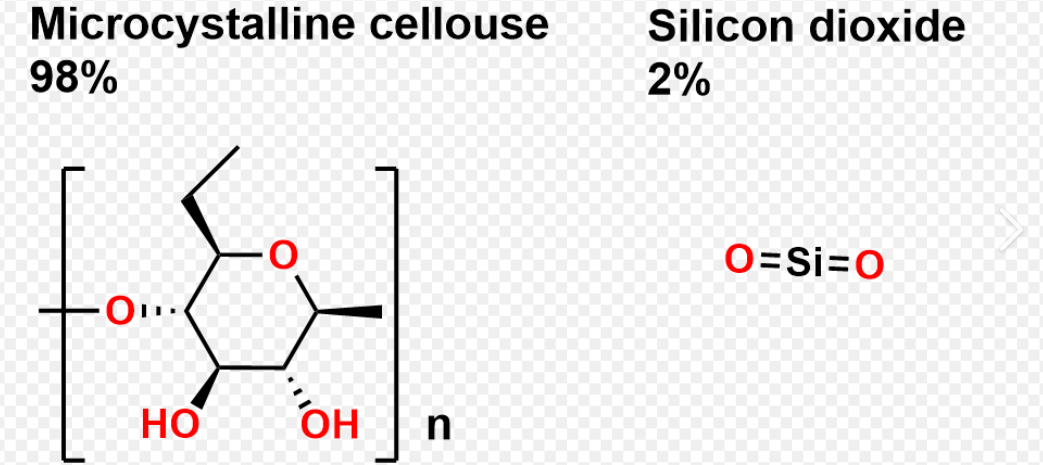
Structural Formula:
SMCC is a co-processed material consisting of MCC and 2% w/w colloidal silicon dioxide. The silicification process does not result in a distinct chemical transformation or noticeable polymorphic change.
Better compressibilitythan MCC.
Plastic deformation behavior.
Relatively chemically inert.
Insoluble in water but retains water absorption and swelling properties similar to MCC.
Good flowability, making it suitable for various direct compression formulations.
Reduced sensitivity to lubricants such as magnesium stearate compared with MCC of the same mean particle size.
Similar to MCC, SMCC is available in differentparticle sizes and bulk densities, making it suitable for various pharmaceutical dosage forms.
3. Key Advantages of Silicified Microcrystalline Cellulose Compared with MCC
Improved flowability: SMCC exhibits better flow properties and density characteristics than MCC, allowing powder blends to move more easily and fill the die cavities more consistently, particularly in direct compression processes.
Enhanced compressibility and tablet formation: SMCC retains the plastic deformation and interparticle bonding capabilities during compression of the MCC matrix, together with good compressibility, supporting the production of tablets with good mechanical strength.
Optimization of direct compression processes: Helps minimize punch sticking and powder blend segregation while supporting consistent tablet weight and content uniformity. This is particularly beneficial for formulations containing low-dose APIs or APIs with poor compressibility.
Reduced sensitivity to lubricants: In one study, SMCC exhibited a lower reduction in tablet mechanical strength than MCC of the same mean particle size in the presence of magnesium stearate, indicating better maintenance of tableting performance under lubricated conditions.
4. Applications and Roles of SMCC in Tablet Formulation
Silicified Microcrystalline Cellulose is used as a filler-binder excipient in tablet formulations:
High drug-loading formulations: High API concentrations can alter the flowability and tableting properties of powder blends. SMCC acts as a filler-binder, supportingpowder flowability and tablet formation within the formulation.
Formulations requiring content uniformity control: Uneven API distribution within a powder blend can affect tablet content uniformity. Thanks to its flow and blending characteristics, SMCC can contribute to improved powder blend uniformity in certain formulations.
Formulations requiring good tabletability: These formulations need to achieve appropriate mechanical strength without necessarily increasing compression force excessively. SMCC, with its good compressibility and plastic deformation properties, supports the formation of tablets with suitable mechanical strength.
Formulations prone to punch sticking during tableting: SMCC helps maintain clean punch surfaces and minimize punch sticking compared with MCC and physical blends of MCC/CSD in certain formulations.
Research Examples of SMCC in Formulations
Active Ingredient – Strength
Dosage Form
SMCC Content (%)
Purpose
Levothyroxine – 0.025 mg *
Tablet
~94.2%
Used as the primary filler at a very high proportion. Thanks to its microporous structure (2–3 µm), SMCC helps capture and protect levothyroxine from degradation.
Loratadine – 10 mg **
ODT
~15.7%
SMCC has an asymmetrical particle structure that helps prevent segregation and maintain powder blend uniformity. In addition, its ability to form mechanically strong tablets at low compression forces, combined with its water absorption mechanism, supports rapid tablet disintegration.
Simvastatin – 10 mg ***
ODT
~46.5%
Acts as a filler excipient in ODT formulations and provides the main compression matrix, supporting rapid tablet disintegration in less than 30 seconds and low friability of less than 1.0%, potentially below 0.2%.
“”, “”, and “” respectively refer to patents US6399101B1, EP1773292B1, and WO2007020079A2.
Analysis of the biological characteristics, endospore formation mechanisms, clinical differences, and probiotic preparations containing Bacillus clausii and Bacillus subtilis.
Learn about Methylene chloride (Dichloromethane – DCM): its physicochemical properties, safety standards, advantages of rapid evaporation, and applications as a film coating solvent and pharmaceutical extractor.
Analysis of the synergistic mechanism between Aluminum Hydroxide, Magnesium Hydroxide, and Simethicone in neutralizing gastric acid, breaking down gas bubbles, and controlling digestive symptoms.
Analysis of technological differences between Dibasic Calcium Phosphate Anhydrous and Dihydrate in terms of physicochemical parameters, surface pH, and application selection of direct compression excipients.
This article provides a detailed analysis of the physicochemical properties, acid neutralization mechanisms, and practical applications of Sodium Bicarbonate and Calcium Carbonate in pharmaceuticals.
Detailed analysis of the physical mechanisms (air traps, shear stress, tensile stress) causing capping, lamination, cracking, and chipping defects. Includes a troubleshooting matrix.
Biorich Group
Thông tin
Biorich Group provides raw materials and supply chain solutions for the pharmaceutical, nutrition, healthcare, cosmetics, food, and industrial sectors, with a global network of partners.
Main category
Loading...
Featured videos
Sign up to receive news
Sign up for our weekly newsletter to get the latest updates.
 (14).png)