Explore softgel capsule formulation, gelatin shell cross-linking mechanisms, key causes, effects on drug release, and strategies to improve capsule stability and disintegration.
1. Overview of Softgel Capsules and Solutions to Mitigate Cross-Linking
a. Basic Structure of Softgel Dosage Forms
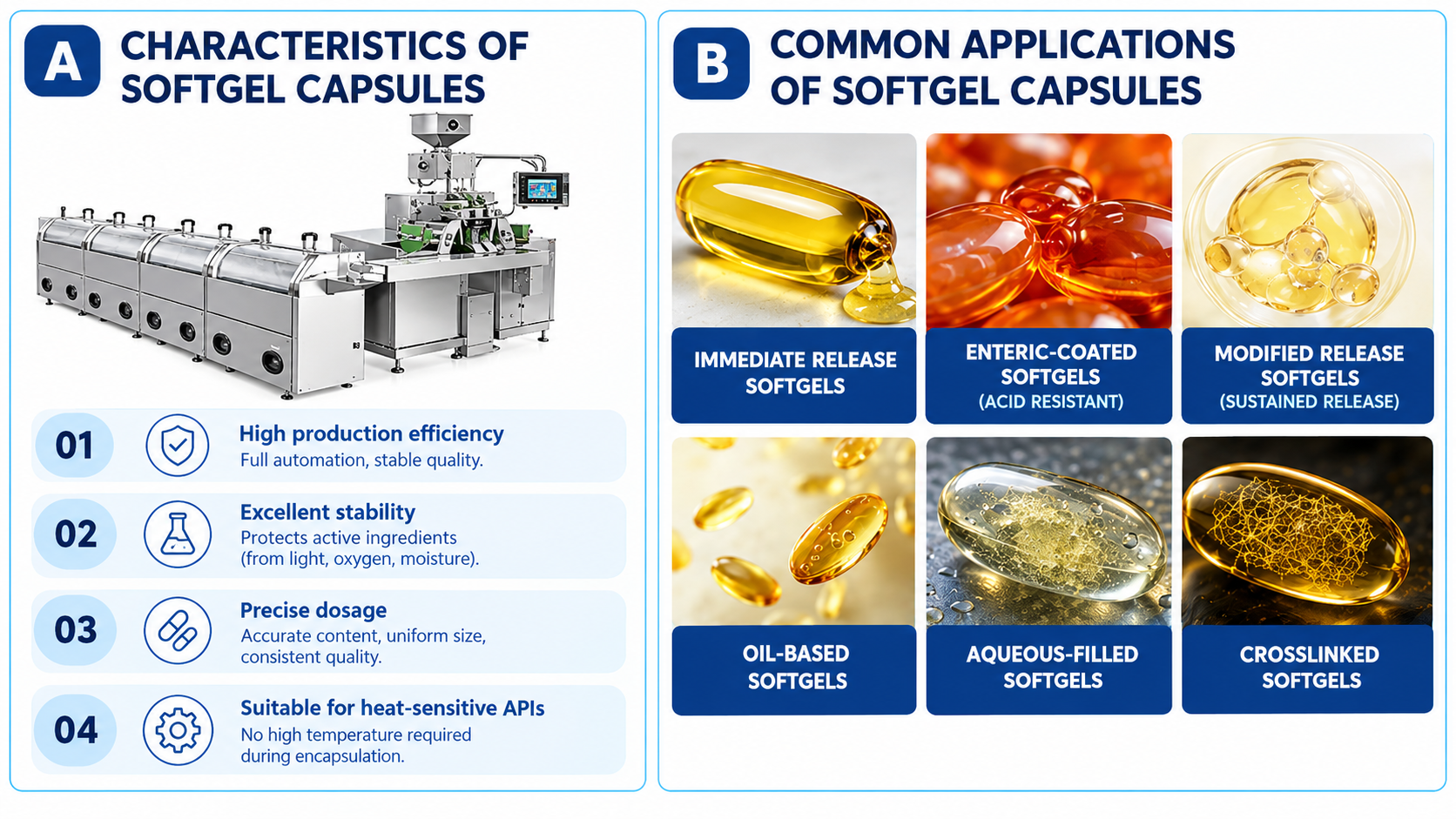
Softgel capsules are widely used pharmaceutical dosage forms consisting of two main components: the shell and the fill material.
The outer shell is primarily composed of Gelatin, plasticizers (Glycerin or Sorbitol), a suitable solvent (usually water), flavoring agents, and coloring agents.
The inner fill is a liquid or semisolid formulation. Depending on the formulation, it may consist of hydrophilic systems (PEG-based), lipophilic systems (various oils), suspensions, or emulsions.
b. Key Advantages of Softgel Capsules in Pharmaceutical Formulation
Convert liquid or semisolid formulations into solid dosage forms, making them easier to administer and swallow while masking unpleasant tastes and odors.
Provide accurate and consistent dosing compared with liquid dosage forms, helping reduce batch-to-batch variability during manufacturing.
Compared with other solid dosage forms, such as tablets and hard capsules, softgel capsules may provide higher bioavailability for certain active pharmaceutical ingredients.
Offer high drug-loading capacity, with the fill material potentially consisting entirely of the drug formulation.
Provide a wide range of shapes and colors, enhancing brand identity and marketing value.
c. Disadvantages and Challenges in Softgel Manufacturing
Complex equipment with numerous adjustable process parameters, making production dependent on operator experience.
Strict manufacturing conditions.
Packaging must be carefully selected to meet storage and stability requirements.
Challenges in maintaining API stability, as some active ingredients may be unsuitable for softgel formulations.
d. Common Problems Encountered During Softgel Formulation
Moisture-sensitive APIs may undergo degradation (Ranitidine) or polymorphic changes (Terazosin).
Strongly acidic or alkaline APIs may cause hydrolysis and leakage of the gelatin shell.
Water-soluble APIs may migrate from the fill into the shell, reducing the API concentration in the fill material.
Water may migrate from the shell into the fill during storage, causing the shell to become hardened and reducing the disintegration of the finished dosage form.
Inappropriate packaging may cause softgel capsules to soften or leak during storage.
Cross-linking of the gelatin shell.
2. Understanding Cross-Linking in Gelatin Capsule Shells
a. What Is Cross-Linking?
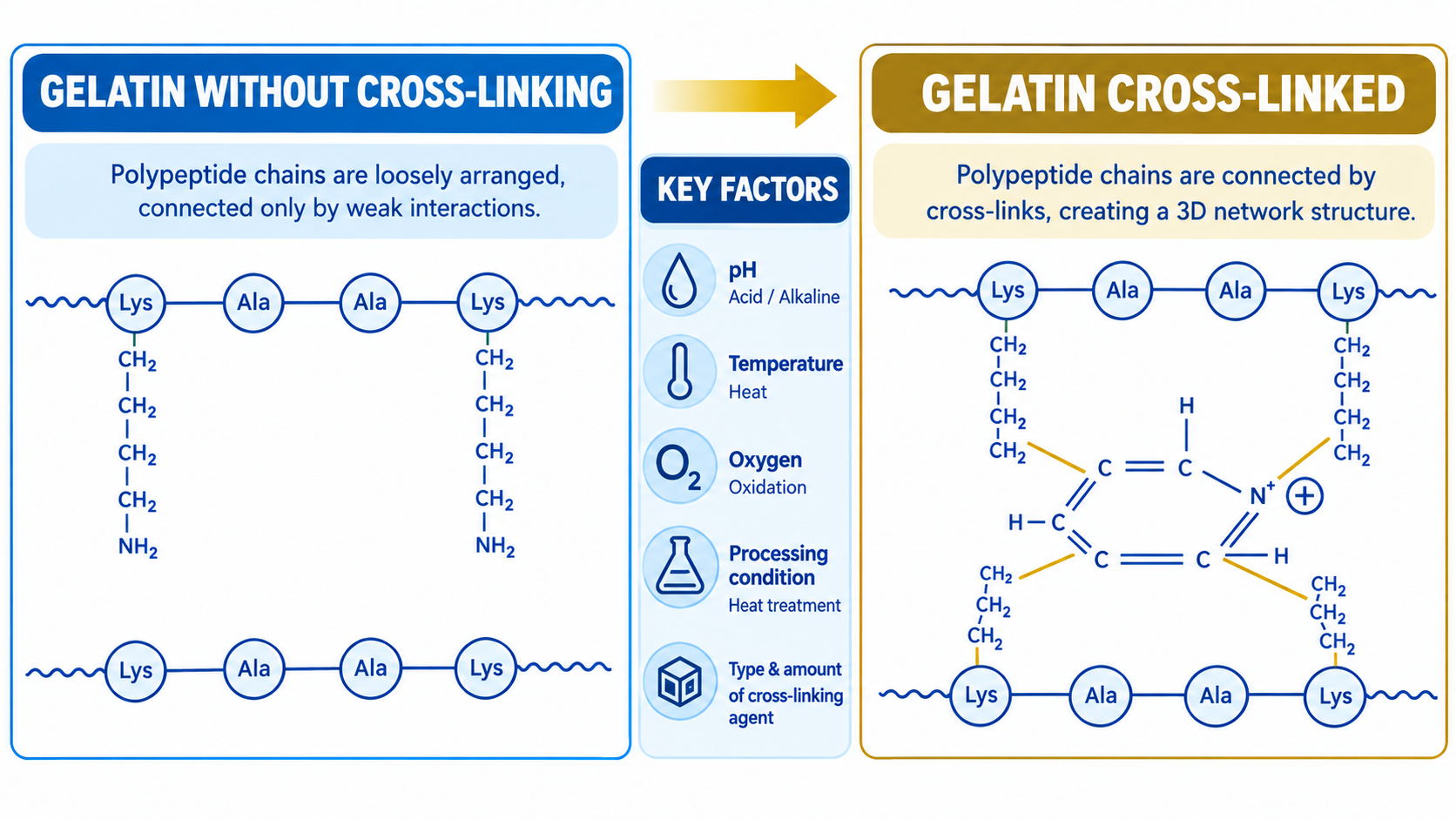
Cross-linking is the formation of covalent bonds between gelatin polypeptide chains. This process may be irreversible and can be promoted by various chemical components within the formulation or by external environmental factors.
Cross-linking reduces gelatin solubility and swelling capacity while increasing gel strength, causing the gelatin shell to become harder. This affects capsule disintegration in aqueous media and simulated gastric conditions, potentially reducing drug dissolution and slowing the release of the active ingredient from the fill.
b. Main Causes of Cross-Linking
The following agents are recognized as potential causes of cross-linking in gelatin softgel shells:
Aldehydes and ketones: These agents can promote cross-links between amino groups on adjacent gelatin chains or within the same chain. The extent of cross-linking is strongly influenced by environmental humidity, with high levels reported at relative humidity levels of approximately 60–70%.
Carbonyl-containing active ingredients: Rofecoxib, Nimesulide, and macrolide antibiotics.
Metal ions, polyol compounds, and substances containing peroxides, epoxides, benzene-related groups, sulfonic acids, or guanidine hydrochlorides.
Environmental factors and improper storage conditions: High temperatures, high humidity, and exposure to light.
c. Strategies to Mitigate Cross-Linking During Manufacturing
Select APIs and excipients that are free of aldehyde, ketone, carbonyl, and other functional groups or agents known to promote cross-linking, where feasible.
Minimize the use of metal ions in softgel formulations.
Maintain appropriate storage conditions to protect softgel capsules from excessive temperature, humidity, and light, and use suitable packaging materials.
Use succinylated gelatin: Gelatin modified through reaction with succinic acid. However, succinylated gelatin may exhibit high permeability to volatile solvents such as ethanol or propylene glycol, making it incompatible with fills containing these solvents. This approach may also be ineffective against cross-linking induced by metal ions.
Use amino acids, particularly Glycine and Lysine. These compounds can act as competing reactants with amino groups in gelatin chains and are commonly used at approximately 0.2–5% of the dry shell mass. In addition, esters of C4–C20 carboxylic acids containing two or three carbonyl groups may be incorporated into the fill or shell to produce a synergistic effect with amino acids.
Use other compounds in the shell, including carboxylic acids (commonly Citric Acid or Succinic Acid), semicarbazide, hydroxylamine hydrochloride, piperazine derivatives, pyridine, pentamethylene imine, glycerine, and p-aminobenzoic acid.
Use ammonium salts to help reduce cross-linking induced by polyol compounds.
Discover the application of Beta Cyclodextrin in improving solubility, increasing bioavailability, and effectively masking the bitter taste of herbal active ingredients.
Learn about Milk Thistle Dry Extract. Discover the mechanism of the active ingredient Silymarin, its advantages, and applications in liver detoxification and hepatocyte protection
Learn what Tyloxapol is. Discover the mechanism, advantages, and applications of the non-ionic surfactant Tyloxapol in eye drops, aerosols, and nano systems.
Standardized Oyster Extract powder rich in natural biological zinc taurine and amino acids to support male vitality boost immunity and enhance physical stamina.
Discover detailed taste masking methods for bitter active pharmaceutical ingredients, the reasons they are necessary, and the excipients used to improve patient treatment compliance.
Biorich Group
Thông tin
Biorich Group provides raw materials and supply chain solutions for the pharmaceutical, nutrition, healthcare, cosmetics, food, and industrial sectors, with a global network of partners.
Main category
Loading...
Featured videos
Sign up to receive news
Sign up for our weekly newsletter to get the latest updates.