(4).png)
1. Applications of Boric Acid in Pharmaceutical Formulation
Boric acid, also known as orthoboric acid, is an inorganic compound with the chemical formula H₃BO₃. It is a weak boron acid that has long been used in the pharmaceutical field due to its mild antiseptic properties, pH-adjusting capabilities, and ability to form buffer systems.
In pharmaceutical formulation and manufacturing, boric acid is used not only as an active ingredient in certain topical preparations but also as a functional excipient in ophthalmic solutions, topical formulations, and some specialized buffer systems. Owing to its relatively high safety profile when applied topically and its compatibility with many other ingredients, boric acid is a commonly used raw material in various pharmaceutical dosage forms.
2. Physicochemical Properties of Boric Acid
- Molecular formula: H₃BO₃
- Molecular weight: 61.83 g/mol
- A weak acid capable of forming complexes with compounds containing diol groups, such as glycerin, mannitol, and sorbitol
- White crystalline powder or colorless crystalline flakes, odorless, with a slightly acidic taste
- More soluble in hot water than in cold water; soluble in glycerin and polyethylene glycol
- Stable under normal storage conditions
- Melting point of approximately 170°C
- Potential interactions with strong alkalis or compounds capable of forming complexes with borate should be considered
3. Benefits of Using Boric Acid as a pH-Adjusting Agent
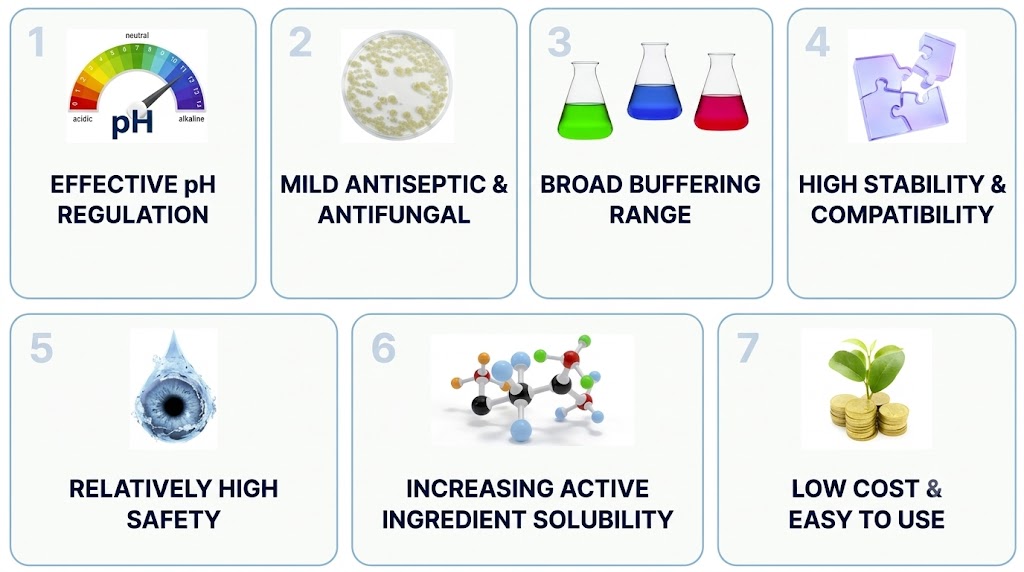
- Effective pH adjustment: Boric acid is commonly combined with sodium borate to form a borate buffer system, helping maintain a stable pH, improve active ingredient stability, and minimize pH changes during storage. This is particularly important for ophthalmic preparations.
- Mild antiseptic and antifungal properties: Boric acid can inhibit bacterial growth and limit the growth of yeasts and molds. These properties may support antimicrobial control in topical preparations.
- Broad buffering range: Applicable as a buffering component in various liquid dosage forms.
- Good stability and compatibility with various active ingredients and excipients: Compatibility must be evaluated for each formulation; interactions may occur with certain components.
- Relatively high safety profile for topical use: At appropriate concentrations and under suitable conditions, boric acid may cause limited irritation to the skin and mucous membranes. It has a long history of use in ophthalmic products, although ocular tolerability and safety must be assessed for each formulation.
- Potential to improve the solubility of certain active ingredients: Through complex formation with polyols or compounds containing adjacent hydroxyl groups, boric acid may help improve the solubility and stability of certain solutions.
- Low cost and ease of use: Boric acid is widely available on the market at a relatively low cost, with straightforward formulation procedures and manageable quality control requirements.
4. Applications of Boric Acid in Liquid Dosage Forms
Ophthalmic Preparations:
- pH-adjusting agent: helps maintain a suitable pH for ophthalmic formulations
- Component of borate buffer systems: supports active ingredient stability
- Osmolality adjustment: may contribute to formulation tonicity and ocular comfort when appropriately formulated
Topical Preparations
- Topical antiseptic solutions: used for their mild antiseptic properties
- Dermatological creams, ointments, and powders: may be used in certain formulations intended to address fungal skin conditions or soothe irritated skin, subject to applicable safety requirements
Vaginal Preparations
- Adjustment of vaginal pH
- Used in certain formulations for recurrent vulvovaginal candidiasis under appropriate medical guidance
- May help inhibit the growth of certain microorganisms
Buffer Systems in Liquid Dosage Forms
- Ophthalmic solutions
- Eye-wash solutions
- Certain topical solutions
Excipient for Tonicity Adjustment
- May contribute to tonicity adjustment in suitable formulations
- May help improve ocular comfort when the formulation is appropriately designed
- Can be incorporated into borate buffer systems, provided compatibility and safety are established
5. Important Considerations When Using Boric Acid in Pharmaceutical Formulation
- Avoid high concentrations in preparations that may result in significant systemic absorption.
- Avoid prolonged use over large areas of damaged skin.
- Exercise caution when formulating products for newborns and young children.
- In multidose ophthalmic preparations, boric acid cannot fully replace a dedicated preservative system.
- Evaluate formulation compatibility when combining boric acid with active ingredients that are sensitive to pH changes or borate ions.