1. Overview of Injectable Drugs and the Role of Formulation Ingredients
Injectable drugs are sterile preparations administered into the body by injection, infusion, or implantation to deliver the active pharmaceutical ingredient (API) directly into the systemic circulation or target tissues.
Compared with oral dosage forms, injectable drugs offer advantages such as high bioavailability, rapid onset of action, and avoidance of gastrointestinal absorption and first-pass hepatic metabolism. However, because they are administered directly into the body, injectable drugs must meet stringent quality requirements.
In addition to the API, excipients play an important role in ensuring the stability, safety, and therapeutic efficacy of injectable preparations. Therefore, excipient selection is a key factor in the research, development, and manufacturing of injectable drugs.
2. Common Classification Methods for Injectable Drugs
Injectable drugs can be classified in various ways according to the route of administration, dispersed system, solvent type (aqueous or oily injections), intended use, or dosage.
In pharmaceutical formulation, one classification method that helps guide excipient selection is based on the dispersed system. Accordingly, injectable drugs are divided into:
Liquid injections: solutions for injection, suspensions for injection, and emulsions for injection
Solid injections: powders for injection intended for reconstitution into solutions or suspensions
3. Detailed Overview of the Main Components of Injectable Drugs
Injectable drugs consist of four main components: the active pharmaceutical ingredient, solvent, excipients, and primary packaging materials that come into direct contact with the product.
a. Requirements for Active Pharmaceutical Ingredients Used in Injectable Preparations
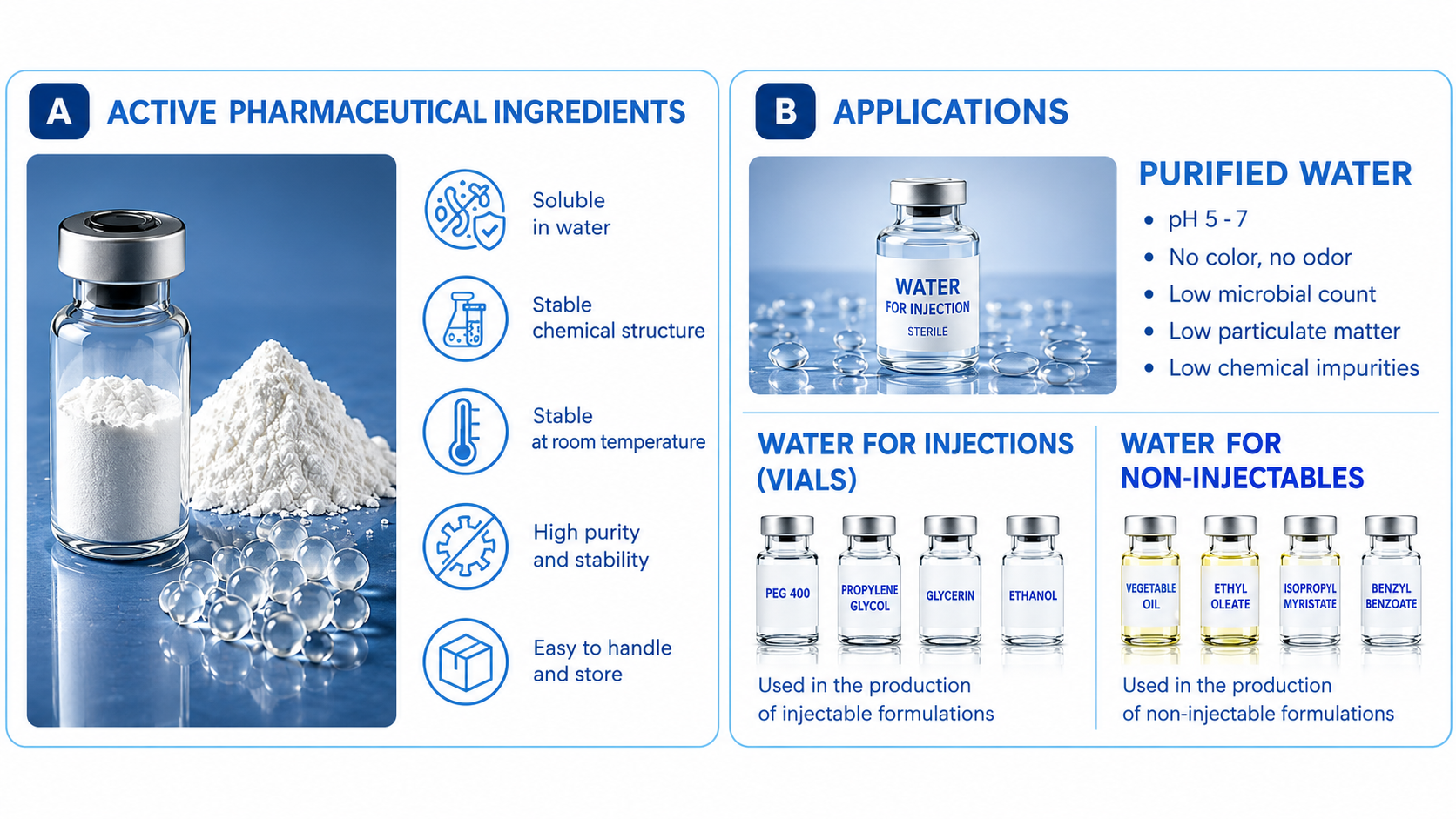
APIs intended for injectable preparations must comply with the relevant requirements for injectable-grade raw materials, including:
Sterility
Pharmaceutical purity
Absence of pyrogens or compliance with bacterial endotoxin limits
Packaging in quantities appropriate for a single injectable manufacturing batch to minimize microbial contamination from the environment
b. Common Solvents Used in Injectable Preparations
Solvents for injectable preparations must meet stringent quality requirements. They should have no undesirable pharmacological effects, be non-toxic, cause no irritation at the injection site, not reduce the therapeutic efficacy of the API, be well tolerated by the body, and be readily eliminated.
Water for Injection: This is the most commonly used solvent in large-scale injectable manufacturing. According to pharmacopoeial requirements, Water for Injection (WFI) is prepared from potable water or purified water by distillation and stored in a closed container for use within 24 hours. WFI must meet specified quality standards, including a clear, colorless appearance, appropriate purity limits, a pH of 5–7, and the absence of pyrogens. In some cases, oxygen and carbon dioxide must be removed. Regarding sterility, non-sterile WFI may be used in the preparation of injections that undergo terminal sterilization, while Sterile Water for Injection is used to dissolve or disperse injectable powders.
Water-miscible solvents: Solvents such as ethanol, glycerin, propylene glycol, and polyethylene glycol are commonly combined with water to improve API solubility or stability. However, these solvents may cause irritation at the injection site or exhibit toxicity, depending on their concentration and the route of administration.
Water-immiscible solvents: Vegetable oils, ethyl oleate, isopropyl myristate, and benzyl benzoate may be used as vehicles for injectable solutions containing APIs that are poorly soluble in water but soluble in oil. Oil-based vehicles may also provide prolonged drug release. However, potential irritation and allergic reactions in certain patients must be considered.
c. Classification of Injectable Excipients and Their Functions
The main groups of excipients commonly used in injectable preparations are summarized in the table below.
Increase API solubility in injectable solutions; improve the physical stability of injectable suspensions. The toxicity of certain surfactants must be considered.
d. Requirements for Injectable Packaging Materials
Packaging materials for injectable drugs must meet the following requirements:
Must not adversely interact with the components of the drug product.
The product-contact surface must remain stable under the high temperatures or pressures encountered during sterilization.
Must protect light-sensitive injectable drugs from light exposure.
Must allow convenient visual inspection of the product for quality assessment.
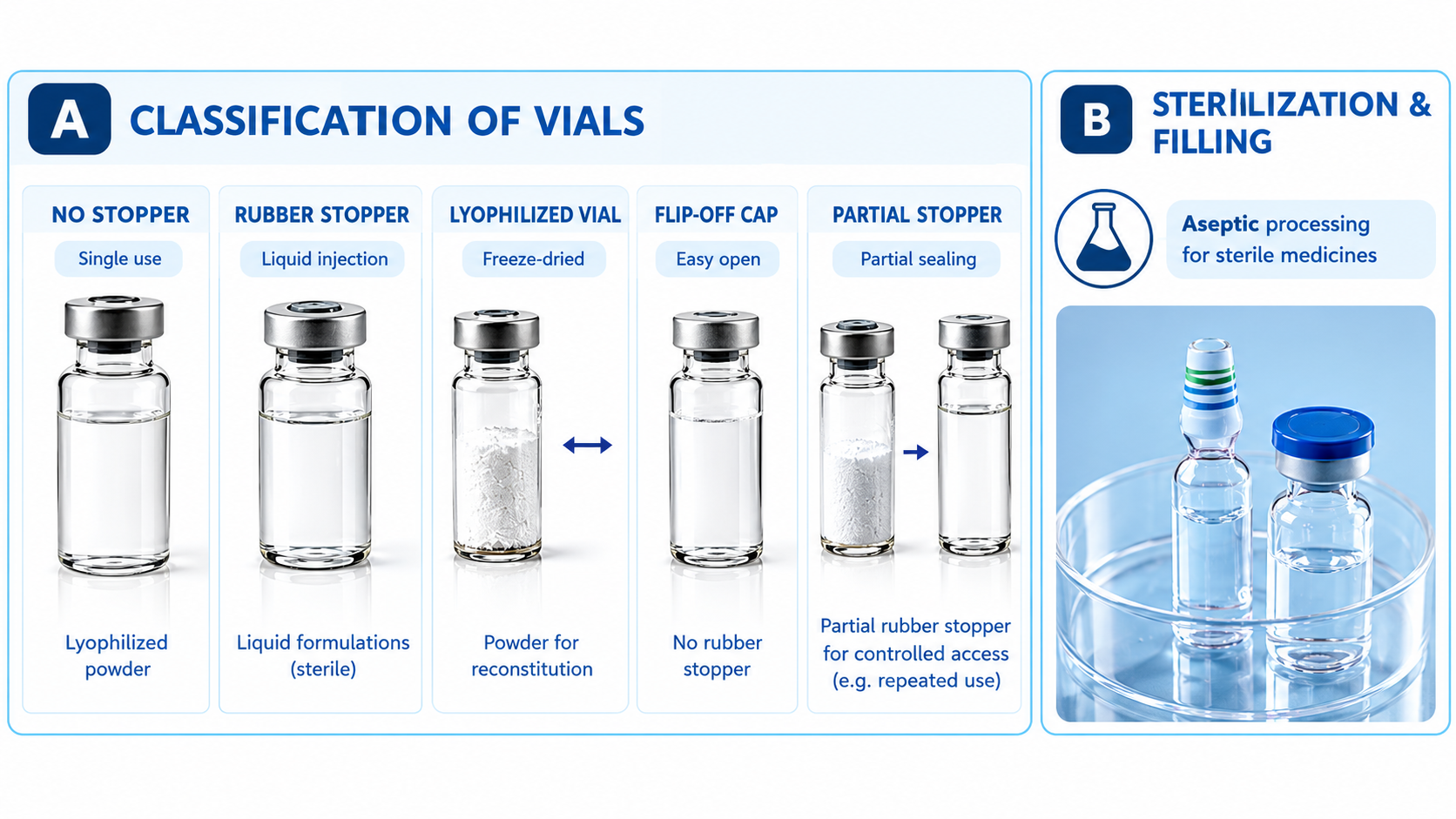
Selected materials must neither compromise product quality nor undergo undesirable changes during sterilization. Common materials include glass and plastic.
4. Injectable Drug Quality Requirements According to Pharmacopoeial Standards
Appearance:
Colorless
Injectable solutions: clear
Injectable suspensions: sediment may form, but the contents must redisperse uniformly upon shaking.
Injectable emulsions: must not exhibit phase separation.
Injectable powders: must rapidly form a clear solution or a homogeneous suspension upon reconstitution.
Identification and assay: Must comply with the applicable pharmacopoeial requirements.
Volume or mass:
Volume: The fill volume must exceed the labeled volume by approximately 100–115%, depending on the volume of the injectable preparation, according to the applicable requirements.
Mass: Must comply with mass uniformity requirements, where applicable.
pH: Must fall within the limits specified by the applicable pharmacopoeia.
Sterility: Injectable preparations must comply with sterility requirements.
Pyrogens (bacterial endotoxins): Intravenous infusions, intravenous injections administered in volumes exceeding 15 mL, injections into cerebrospinal fluid, ophthalmic injections, and injections into joint capsules must meet the applicable pyrogen or bacterial endotoxin requirements.
Isotonicity: Aqueous injectable solutions should preferably be isotonic with body fluids to improve tolerability and reduce pain or discomfort at the injection site.
Discover the application of Beta Cyclodextrin in improving solubility, increasing bioavailability, and effectively masking the bitter taste of herbal active ingredients.
Learn about Milk Thistle Dry Extract. Discover the mechanism of the active ingredient Silymarin, its advantages, and applications in liver detoxification and hepatocyte protection
Learn what Tyloxapol is. Discover the mechanism, advantages, and applications of the non-ionic surfactant Tyloxapol in eye drops, aerosols, and nano systems.
Explore softgel capsule formulation, gelatin shell cross-linking mechanisms, key causes, effects on drug release, and strategies to improve capsule stability and disintegration.
Standardized Oyster Extract powder rich in natural biological zinc taurine and amino acids to support male vitality boost immunity and enhance physical stamina.
Discover detailed taste masking methods for bitter active pharmaceutical ingredients, the reasons they are necessary, and the excipients used to improve patient treatment compliance.
Biorich Group
Thông tin
Biorich Group provides raw materials and supply chain solutions for the pharmaceutical, nutrition, healthcare, cosmetics, food, and industrial sectors, with a global network of partners.
Main category
Loading...
Featured videos
Sign up to receive news
Sign up for our weekly newsletter to get the latest updates.
(3).png)