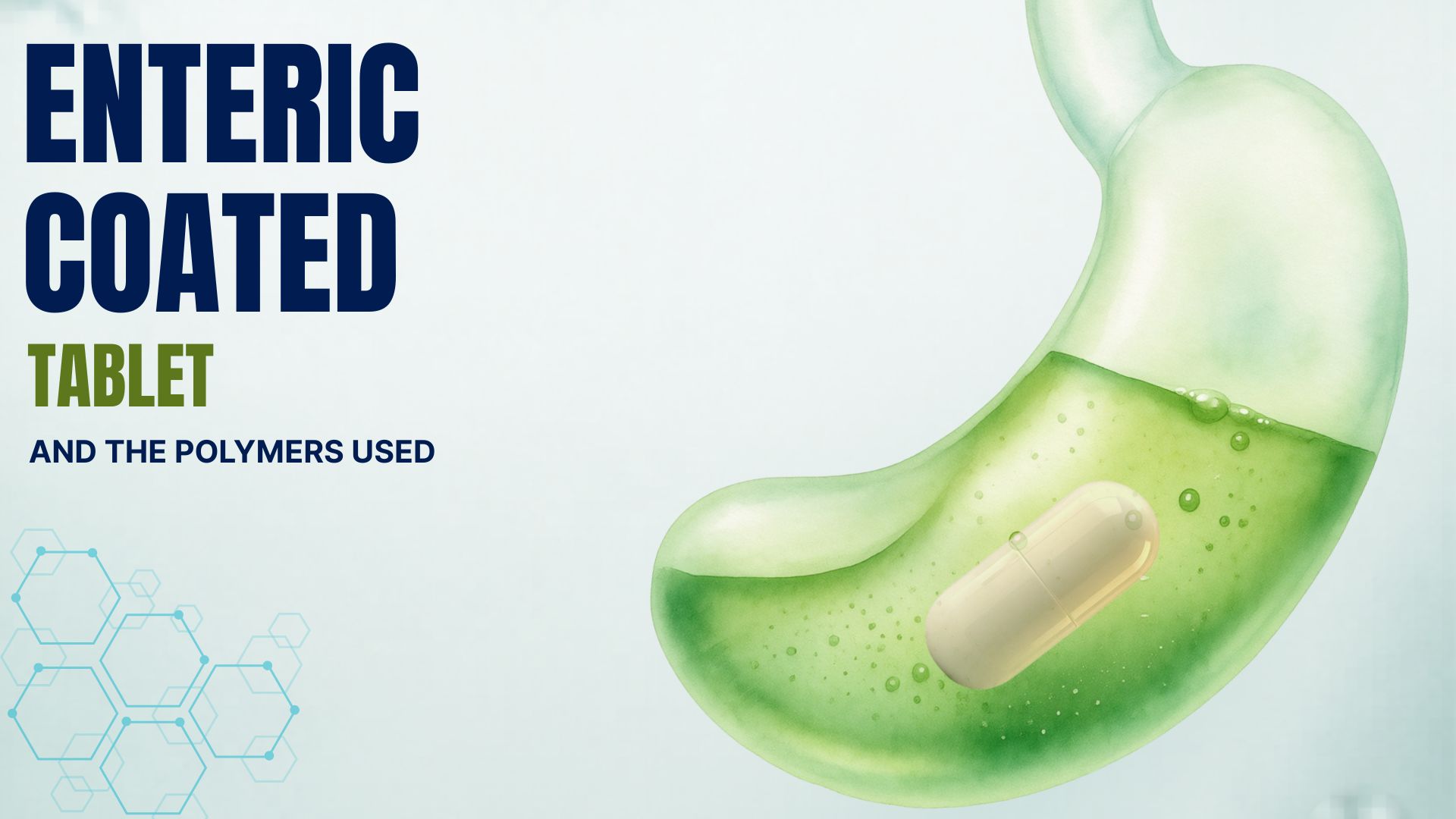
Enteric-coated tablets are a dosage form coated with a polymer film capable of resisting the acidic environment of the stomach and releasing the active ingredient when it reaches a higher pH environment in the gastrointestinal (GI) tract. This technology is used to control the site of active ingredient release, protect acid-sensitive active ingredients, or limit the contact of active ingredients with the gastric mucosa.
Compared to some other GI drug delivery systems, enteric film coating is a relatively common technique in tablet manufacturing. However, formulation development still requires strict control over the polymer type, coating thickness, film-forming capability, coating conditions, and dissolution characteristics of the coating system to achieve the desired release profile.
An ideal enteric coating film must maintain its integrity in an acidic environment for the required duration, then rapidly dissolve or lose its release-hindering properties when transitioning to a higher pH environment.
Evaluation criteria typically include:
.jpg)
Active ingredients easily destroyed by gastric juice
Active ingredients causing irritation or damage to the gastric mucosa
Active ingredients requiring local action or release at specific sites in the intestine
Food oils and supplements
Some medications for GI diseases are designed to release the active ingredient in the small intestine, ileum, or colon to increase the drug concentration at the site of action.
Examples:
Choosing an enteric coating polymer depends on multiple factors, including the active ingredient's properties, desired release site, polymer dissolution pH, film-forming ability, compatibility with excipients, coating method, and product stability requirements.
An enteric coating polymer should:
| Polymer Group | Polymer | Characteristics / Applications | Dissolution pH / Notes |
|---|---|---|---|
| Cellulose derivative | Cellulose acetate phthalate (CAP) | Classic enteric coating polymer; dissolves as pH increases. | pH ≥ 6.0. Actual value depends on polymer properties and testing conditions. |
| Cellulose derivative | Hydroxypropyl methylcellulose phthalate (HPMCP) | Common enteric coating polymer; available in multiple grades with distinct dissolution profiles. | Depends on polymer grade and testing conditions. |
| Cellulose derivative | Hydroxypropyl methylcellulose acetate succinate (HPMCAS) | Features multiple grades with pH-dependent dissolution; grades can be selected to adjust release site. | Some grades have a dissolution threshold around pH 5.5, others have higher pH thresholds. |
| Cellulose derivative | Cellulose acetate trimellitate (CAT) | Cellulose derivative with pH-dependent dissolution. | Depends on polymer properties and testing conditions. |
| Cellulose derivative | Hydroxypropyl ethylcellulose phthalate | Cellulose phthalate derivative capable of film formation and pH-dependent dissolution. | Depends on polymer properties and testing conditions. |
| Polyvinyl derivative | Polyvinyl acetate phthalate (PVAP) | Offers acid resistance and permits drug release in higher pH environments. | pH ≥ 5.0. |
| Methacrylic acid polymer | Eudragit L 100-55 | Copolymer commonly used for small intestine release systems. | pH ≥ 5.5. |
| Methacrylic acid polymer | Eudragit L 30 D-55 | Aqueous dispersion form, ideal for water-based film coating processes. | pH ≥ 5.5. |
| Methacrylic acid polymer | Eudragit L 100 | Used when active ingredient release is required in higher pH environments. | pH ≥ 6.0. |
| Methacrylic acid polymer | Eudragit S 100 | Often considered when targeting drug release in the distal intestine or colon. | pH ≥ 7.0. |
| Naturally derived polymer | Shellac | Natural polymer with pH-dependent properties; historically used in enteric coatings. | Properties depend on raw material source, processing, and storage conditions. |
| Naturally derived polymer | Sodium alginate | Gel-forming polysaccharide; frequently used in matrix and controlled-release systems. | Can participate in pH-dependent release systems but is not a classic enteric coating polymer. |
Enteric film coating is a critical technology in oral dosage form development, especially for active ingredients that are acid-sensitive, cause GI irritation, or require targeted release within the GI tract.
In R&D practice, polymer selection should not rely solely on a single dissolution pH value. Formulators must concurrently consider the specific polymer type and grade, active ingredient properties, absorption/action site, coating thickness, plasticizer, coating method, storage conditions, and the desired release profile.
Polymer groups such as CAP, HPMCP, HPMCAS, PVAP, and methacrylic acid polymers remain essential choices in developing enteric coating systems. Selecting the correct polymer and optimizing the coating system are decisive factors in achieving the targeted acid resistance, stability, and active ingredient release.