Explore the role of superdisintegrants in solid dosage formulation, along with their mechanisms of action, characteristics of common superdisintegrants, and selection criteria to optimize the disintegration rate, dissolution, and bioavailability of the active pharmaceutical ingredient (API).
Superdisintegrants are essential excipients in solid dosage forms, serving the following key functions:
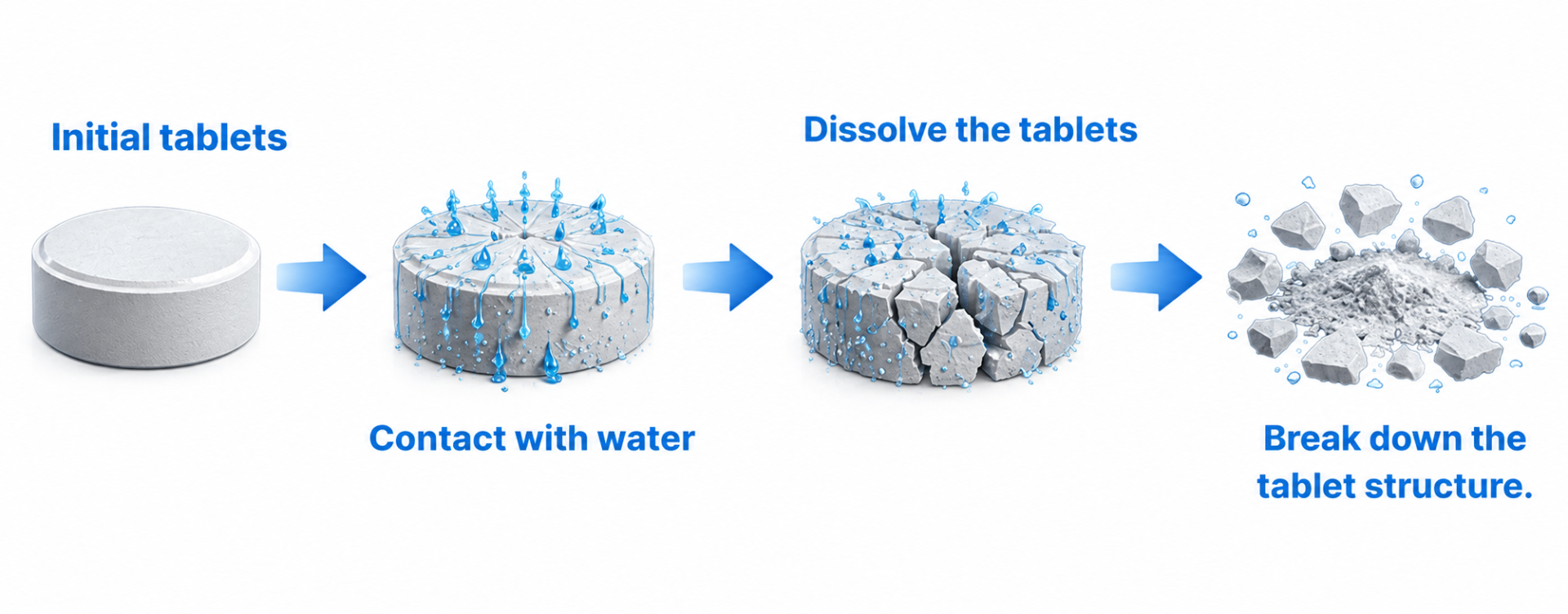
Enhancing tablet disintegration: facilitating the rapid breakdown of the tablet structure upon contact with gastrointestinal fluids.
Improving drug dissolution, solubility, and bioavailability: particularly for poorly water-soluble active pharmaceutical ingredients (APIs).
To effectively perform these functions, a superdisintegrant should possess the following characteristics, depending on the dosage form, API properties, and manufacturing process:
Rapid disintegration at low use levels.
Good flowability, particularly for tablets manufactured by direct compression.
Excellent compressibility, enabling the production of tablets with high hardness and low friability.
Efficient wetting and water-wicking capability.
No incompatibility with ionic compounds when ionic APIs or excipients are present in the formulation.
No adverse impact on the drug release profile, particularly in modified-release dosage forms.
Consistent water uptake and swelling performance over a wide pH range.
2. Mechanisms of Tablet Disintegration by Superdisintegrants
Typically, superdisintegrants function primarily via three mechanisms: swelling, wicking, and shape recovery:
Disintegration Mechanism
Description
Application
(swelling)
Upon contact with water, the excipient swells and ruptures the tablet structure from within.
The excipient draws water into the tablet via capillary action, dissolving the tablet components from within.
deal for formulations containing highly water-soluble ingredients (e.g., lactose, mannitol, sugars, and polyols).
(Shape Recovery)
Upon exposure to water, excipient particles tend to revert to their pre-compression shape, thereby breaking the tablet matrix and facilitating disintegration.
Suitable for most applications, particularly for tablets that are challenging to disintegrate.
Most contemporary superdisintegrants operate via a combination of the aforementioned mechanisms to varying degrees.
3. Common Superdisintegrants
a. Sodium starch glycolate: Sodium salt of cross-linked carboxymethyl starch
Exhibits strong swelling capacity, particularly grades derived from potato starch (swelling up to 200 times the initial volume)
Suitable for poorly soluble active pharmaceutical ingredients (APIs)
Swells to form a gel; therefore, usage > 8% in the formulation poses a risk of compromising tablet disintegration and API release
Discover the application of Beta Cyclodextrin in improving solubility, increasing bioavailability, and effectively masking the bitter taste of herbal active ingredients.
Learn in detail about sucrose excipients in pharmaceutical preparations. Explore the properties, advantages, and applications of sucrose in manufacturing tablets and liquid medications.
Explore boric acid applications in pharmaceutical formulation, including its physicochemical properties, use in ophthalmic preparations and borate buffer systems, and key safety considerations.
Learn about Milk Thistle Dry Extract. Discover the mechanism of the active ingredient Silymarin, its advantages, and applications in liver detoxification and hepatocyte protection
Learn what Tyloxapol is. Discover the mechanism, advantages, and applications of the non-ionic surfactant Tyloxapol in eye drops, aerosols, and nano systems.
Explore softgel capsule formulation, gelatin shell cross-linking mechanisms, key causes, effects on drug release, and strategies to improve capsule stability and disintegration.
Biorich Group
Thông tin
Biorich Group provides raw materials and supply chain solutions for the pharmaceutical, nutrition, healthcare, cosmetics, food, and industrial sectors, with a global network of partners.
Main category
Loading...
Featured videos
Sign up to receive news
Sign up for our weekly newsletter to get the latest updates.
.jpg)
.jpg)