(5).png)
1. Overview of Sucrose in Pharmaceuticals
Sucrose (saccharose or cane sugar) is a naturally occurring disaccharide composed of one glucose molecule and one fructose molecule linked by a glycosidic bond. With the molecular formula C₁₂H₂₂O₁₁, sucrose is one of the most widely used excipients in the pharmaceutical industry due to its pleasant sweetness, established safety profile, and multifunctional properties.
In pharmaceutical formulation, sucrose is used not only as a sweetening agent but also serves multiple roles, including as a diluent, binder, and agent for imparting consistency, structure, and stability to various dosage forms. Thanks to its versatility and compatibility with many active pharmaceutical ingredients (APIs), sucrose is found in solid dosage forms such as tablets, sugar-coated tablets, powders, and sachets, as well as liquid dosage forms such as syrups and oral suspensions.
2. Analysis of Sucrose Properties in Pharmaceutical Manufacturing
2.1. Chemical Characteristics of the Sucrose Molecule
- Molecular formula: C₁₂H₂₂O₁₁
- Molecular weight: 342.30 g/mol
- A disaccharide composed of glucose and fructose.
- A non-reducing sugar because it has no free aldehyde or ketone group.
- Can be hydrolyzed under acidic conditions to produce glucose and fructose.
- Stable in neutral environments and under normal storage conditions.
2.2. Key Physical Properties of Sucrose
- White crystalline solid or white crystalline powder.
- Odorless with a pleasant sweet taste.
- Its relative sweetness is conventionally assigned a value of 100 and is commonly used as a reference for comparing other sweeteners.
- Highly soluble in water, practically insoluble in ethanol and non-polar organic solvents.
- Less hygroscopic than many polyols.
2.3. Functional Properties of Sucrose in Pharmaceutical Manufacturing
- Exhibits brittle fracture behavior, providing relatively good compactibility during tablet compression.
- Capable of forming an attractive, glossy coating on sugar-coated tablets.
- In liquid formulations, sucrose produces viscous solutions that contribute to the consistency of the preparation.
- May exhibit mild antimicrobial and antifungal effects at sufficiently high concentrations.
- Easily combined with many other excipients in a formulation.
3. Key Advantages of Sucrose in Pharmaceutical Formulation
- Effective sweetening and taste masking: Sucrose is one of the most effective natural sweeteners for taste masking. It helps reduce the bitter or astringent taste of certain active ingredients and improves patient acceptability.
- Established safety profile: Sucrose has a long history of use in food and pharmaceutical products and generally has low toxicity. It is widely accepted for pharmaceutical use, subject to applicable regulatory requirements, and is suitable for many patient populations.
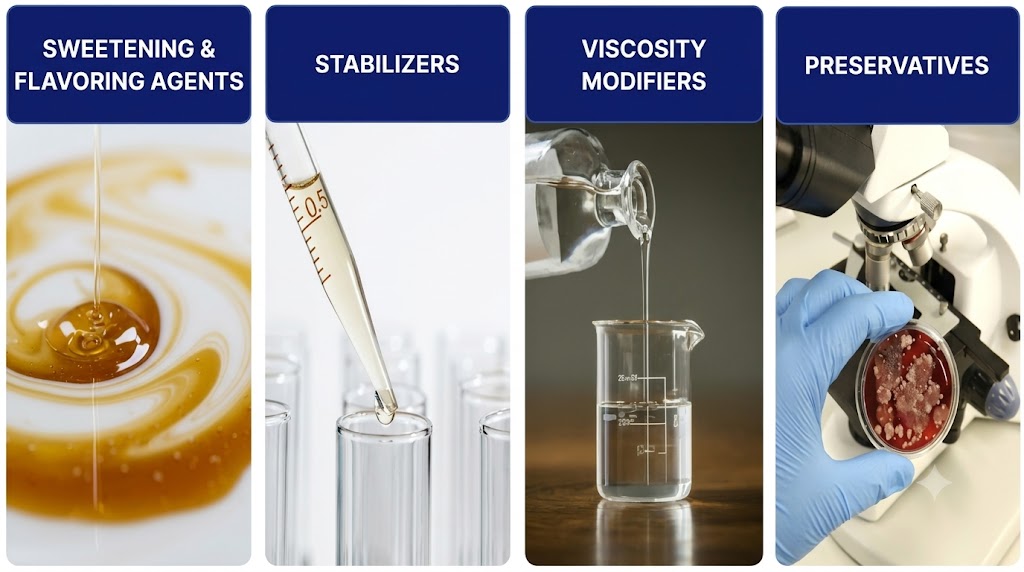
- Multifunctionality: Sucrose can perform several functions within a single formulation, including taste masking, serving as a diluent and binder, improving consistency and structure, increasing viscosity, helping stabilize preparations, and providing mild antimicrobial and antifungal effects at high concentrations.
- Stabilization of proteins and biopharmaceuticals: Sucrose is widely used as an excipient in biological products such as vaccines, recombinant proteins, monoclonal antibodies, and lyophilized preparations. It can help limit protein denaturation, preserve the structural integrity of biomolecules, and reduce aggregation during freeze-drying and storage.
4. Applications of Sucrose in the Pharmaceutical Industry
- Sweetening and taste-masking agent: Provides a pleasant sweetness and helps mask bitter, astringent, or unpleasant tastes in oral liquid preparations, powders and sachets, chewable tablets, lozenges, and orally disintegrating tablets (ODTs).
- Stabilizing agent: Sucrose has no reducing activity under normal conditions and can help stabilize certain formulations. Its effects on oxidation and overall product stability depend on the active ingredient and formulation conditions.
- Viscosity-modifying agent: Sucrose dissolved in water forms viscous syrups, helping increase viscosity and stabilize liquid preparations. In oral suspensions, increased viscosity can reduce the sedimentation rate of particles during storage and use.
- Preservative effect: At high concentrations, sucrose creates high osmotic pressure that draws water out of microbial cells and inhibits their growth. Therefore, sucrose may contribute to the preservation of liquid pharmaceutical preparations when used at sufficiently high concentrations, although its effectiveness depends on the formulation and does not replace the need for appropriate preservation and microbial quality controls.
5. Pharmaceutical Dosage Forms Containing Sucrose as an Excipient
Sucrose is widely used in the following pharmaceutical dosage forms:
- Solid dosage forms: tablets, sugar-coated tablets, chewable tablets, lozenges, orally disintegrating tablets (ODTs), powders, and sachets.
- Sucrose is a sugar with brittle fracture behavior, which can provide relatively good compactibility when used as a diluent in tablet compression.
- Some co-processed sucrose excipients improve flowability and compactibility when used as tablet diluents.
- Capable of forming an attractive, glossy coating on sugar-coated tablets.
- In chewable tablets, lozenges, and ODTs, sucrose provides a pleasant sweet taste and helps mask some of the bitter or astringent taste of the formulation.
- Liquid dosage forms: syrups, suspensions, and solutions.
- Sweetening and taste-masking agent.
- Increases viscosity and helps stabilize preparations.
- Provides a preservative effect at sufficiently high concentrations.